


“Ooh, your kisses, sweeter than honey, and guess what? So is my money! All I want you to do for me is give it to me when you get home.” From Respect, written by Otis Redding.
 Back in the day — it wasn’t that long ago — if an adult was spied reading comic books, that adult was perceived as a person of obviously low intelligence who was incapable of reading more sophisticated material popular at the time… like, say, the works of Jacqueline Susann.
You are likely familiar with the efforts of psychiatrist Fredric Wertham, anti-comics crusader and author of Seduction of the Innocent which detailed a causal relationship between comic books and juvenile delinquency. That was a big deal back in the late 1940s through much of the 1950s, when parents started to dislike taking responsibility for the way they raise their children. Of course, by “detailed” I mean “made-up.” Fred later recanted and, of all things, promoted comics fandom as a positive force.
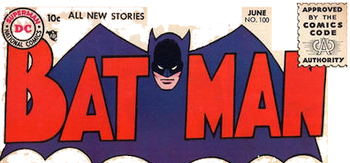
 Comic book burnings were rather common, back at a time when you could still burn fallen leaves. In an attempt to survive, most publishers bundled themselves together in an organization called “The Comics Magazine Association of America,” and they issued a (then) strict code detailing what publishers can not do in their stories. It was as remarkably restrictive as it was completely silly. Even stories that first appeared in newspaper comic strip sections before millions and millions of family people were heavily censored when reprinted in comic book form.
It didn’t help. The Code probably would not have been effective had there actually been a connection between comic books and juvenile delinquency. Some newsstands and similar comics outlets started to limit or remove the 36-page booklets from their shelves. Religious institutions and asshole talking heads on the newly-born medium of television wouldn’t stop their mindless attack on our medium — at a time when costumed heroes of various sorts were getting their own teevee shows. Dozens of publishers went out of business, and those writers and artists who continued to get work often had to endure pay cuts. When asked about their occupation at those tweedy cocktail parties of the time, many of those same folks responded “commercial artist” instead of fessing up to the truth: they were, in fact, some sort of child molester.
The assault lasted maybe a bit over a decade, including the “petering out” period. Rock’n’roll came along, and it turned out American roots music was the real culprit after all. Bigger names came out against it, including a lot of pop singers who were afraid they would lose their careers because they could not rock. Umm tut sut…
 Respectability started to ease back into four-colors in the mid-1960s when Stan Lee began getting invitations to speak at colleges. The overly maligned writer/editor got himself booked on all sorts of teevee talk shows and was a strong and effective advocate. The popularity of the purposely childish Batman show played into this very effectively.
Then 1978 happened, and Richard Donner made the first superhero movie that was not just for kids, that embraced the same slickness and storytelling techniques as blockbusters such as The Godfather and Taxi Driver. It made a fortune, and that generally brings respectability along riding shotgun.
I could finally read comic books on public transportation without scaring the proletariat. Not that that had stopped me before: in the early 1970s people just assumed hippies were stupid. At least until their kids started to play along with us.
I say this not just to wax poetic about past victories, but to note the annual comics soirée held for the past several decades by my dear friend of nearly a half-century, the great Martha Thomases. It is a remarkable affair that attracts many of the biggest and brightest and funniest people who could make it to Manhattan’s West Village to eat fancy donuts, scarf down deli sandwiches, and talk our brains out. I’m serious: I started going deaf almost a decade ago, but in order to continue my participation in the event, I have spent over nine thousand dollars on hearing aids. Honest; there really isn’t a lot of other reasons for me to want the damn things.
Martha, I suspect you might be a bit taken aback at my promoting your efforts at bringing our medium respectability. Well, at least making us look a bit more respectable. It’s a great party, and I am hardly the only septuagenarian who looks forward eagerly to the event.
And yes, on my train back from Grand Central Terminal to my Connecticut abode, I did indeed read comic books. In public.
The way they were meant to be read.
