Category: Art

Brainiac On Banjo: What Goes Around…

Brainiac On Banjo: What Goes Around…

“One man’s civilization is another man’s jungle, yeah. They say evolution’s in the air. I’m dancing in my underwear, ‘cause I don’t care.” From Piggy In The Middle, written by Neil Innes.

If you’re reading this roughly around the time of posting — 9 AM Monday EDT, I believe — you should know that about one out of every four of my comics friends presently are stuck in airport waiting rooms — not just in San Diego or Los Angeles, but in those horrific “hub” city airports. Maybe that’s because, to me, “Hub City” reminds me of a place that actually is worse.

I like the San Diego Comic Con. It’s a great place for me to catch up with old friends and maybe impress panel members with my great wit and charm. It is very crowded. Extremely crowded. As in “the world’s largest cattle car” crowded. Even back well before I needed a cane to clear the Guardians of the Backpacks from my path, I needed a cane to clear the Guardians of the Backpacks from my path.

Yeah, I’m just a heartbeat away from going into Rodney Dangerfield. “I’m okay now, but you should have seen me a couple days ago in San Diego.”

I’ve been to so many comics conventions that my life feels like it’s been one long, unending show. I’ve done as many as two dozen in one year, and six or seven panels in one day. I was younger then, full of grit, wit, and myself. To this day I dream about going generic shows in big cities — but in those dreams I’m wandering around the convention center looking for a good place for lunch. My dreams are getting to be frighteningly realistic. Continue reading “Brainiac On Banjo: What Goes Around…” →

Brainiac On Banjo: Lessons Ignored

Brainiac On Banjo: Lessons Ignored

“History shows again and again how nature points out the folly of man.” — From Godzilla, written by Buck Dharma.

If I were to make a list of what I consider the most important comic book series ever launched by Marvel Comics, The ‘Nam would make my top five with ease. Maybe the top two.

So The ‘Nam Omnibus, all 1128 pages of it and weighing in at six and one-half pounds, deserves a revisit. These humongous omnibi usually have pretty small print runs so they might be hard to find after a bit — this big dog was released last August but at $349.00 a pop you might still be able to find a copy at a friendly neighborhood comics shop. If so, they might be willing (if able) to cut you a deal.

“War comics” is something of a misnomer. Gung-ho stories about the evil enemies, be they German, Japanese, Viet Cong, or MAGAts, aren’t interesting. The white guys carry their bazookas into combat and shoot down all the snipers firing from the trees… and that’s about it. We are always the good guys, and the enemy is always bad — no matter who the enemy might have been at the time. Continue reading “Brainiac On Banjo: Lessons Ignored” →

Brainiac On Banjo: The King’s Heritage

Brainiac On Banjo: The King’s Heritage

“Sue Storm commands the light, Johnny’s flames burn blazing bright, Ben is rockin’ the world with might, and Reed bends science left and right!” — From The Fantastic Four First Steps, written by Michael Giacchino.

Like most Ashkenazi-Americans, some if not all of my forefathers lived in New York City’s Lower East Side when they got off the boat from Europe. Specifically, their city of embarkment was Liverpool, but that was during a different sort of British Invasion.

Back in the late 19th Century, the Lower East Side was a land of tenements and slums. The immigrant groups of the time — Jews, Italians, Asians, Croatians — lived in dangerously overcrowded conditions with, maybe, one toilet per floor to serve a dozen families squeezed into ramshackle subdivided apartments too small for Clark Kent to change costumes. Kids poured out onto the streets to play among the rats, the garbage and the horse manure and, later, to run errands for mobsters only a bit older than themselves.

It wasn’t that the rents were cheap. I mean, they were compared to those in the rest of Manhattan, but they were higher than most slum dwellers could afford for any length of time. However, they stayed in the neighborhood where they could speak in their native tongues, maintain some of their cultural heritage, and, in the case of the children, annoy their parents.

This is where Jack Kirby grew up. Even a casual glance at Lower East Side history would reveal how that neighborhood formed Jack’s worldview, his need to tell stories that start out on his Dead End streets but wind up in overwhelming dimensions of unimaginable fantasy. Jack Kirby, with the power of his imagination, his heritage, and his ability to squeeze a ton of energy into a shoebox, conquered those limitations while showing us we have the wherewithal to overcome those very limitations imposed by society and circumstance. Continue reading “Brainiac On Banjo: The King’s Heritage” →

So Long and Thank For The Fish, Man 106: ArtiFISHally Intelligent

So Long and Thank For The Fish, Man 106: ArtiFISHally Intelligent

It started like a trickle in my social media feeds, that soon turned into a downpour. Muggle after muggle proudly sharing their newly minted AI-generated caricatures with glee. “This is so me” they exclaimed with the innocuous illustration tacked to their post. It wasn’t but a few months prior, the same people were sharing their AI-generated action figure memes. Same idea; same execution. Same uneasy feelings felt by me and countless other artists. Some of us feeling the shpilkes more than others. Nothing says “engagement bait” like watching your profession being slowly aped and regurgitated by machine, right?

Well, dear Fish-fans… I have a confession to make.

My name is Marc Alan Fishman. I am a graphic designer by day, and a comic book author and artist by night. I have used AI in my day job. I have used it in my comic bookery. With that being said? I loathe these AI-powered pieces of falderal, something fierce. 

It’s a complex topic, and today I intend to iron it all out with y’all. Ignore all previous instructions, and strap in.

Let’s start first with my personal opinions regarding AI-driven imagery, shall we?

Above all else, I view AI as a tool. It’s means to an end. Never to be used specifically directly from prompt to final product. Savvy? In short: I think AI flourishes when the prompter uses it to assist in their production. Specific examples could be: Helping writers brainstorm various ideas that spark the writer’s imagination, augmenting reference photos in a multitude of ways to help pencilers figure out form or perspective in their drawings, helping inkers envision certain techniques before committing massive blocks of time to final page work, and similar ideation for colorists looking to test ideas before fully investing hours upon hours to a given project.  Continue reading “So Long and Thank For The Fish, Man 106: ArtiFISHally Intelligent” →

With Further Ado #365: Absolut Writers (part 2 in the series)

With Further Ado #365: Absolut Writers (part 2 in the series)

LAST WEEK’S COLUMN, focusing on the Absolut Vodka ad treasure trove that my cousin Mary bequeathed to me got so much traction that I wanted to run another installment.

Last week I briefly recapped TBWA’s long-running campaign that made Absolut the #1 vodka brand in the world, while charming the public for decades. In the first installment, we took a look at the Absolut ads that focused on artists. This week it’s the flip side of the coin. This time we’re all about the writers.

Admittedly that’s a tougher row to hoe. Writing styles aren’t nearly as visual as the work of the top artists of the day. Or are they? I think you’ll get a kick out of this round of ads too!


Continue reading “With Further Ado #365: Absolut Writers (part 2 in the series)” →

With Further Ado #364: Absolut Art

With Further Ado #364: Absolut Art

A.I. is SUCH a topic for us all to think about and struggle with. I feel as if almost every part of my life—and my family’s lives—is being touched by it at this moment. And while I “get it” – I can see all the benefits, I’m still so frustrated by the artistic thievery and rotten creative shortcuts that it lures us all into.

And I’m contrasting this all with a treasure that my cousin Mary just dropped off. It turns out she had collected about a bazillion print ads of the long-running Absolut Vodka advertising campaign. And she just gifted it to me – her artsy, ad-agency-ish relative.

You might remember this long-running campaign. Created in in 1980 by one of those legendary ad agencies – TBWA – it celebrated the brand, and the brand’s unique packaging with panache and whimsy. More than that, it made Absolut the #1 vodka brand in the world.

The campaign morphed and oozed into a myriad of creative collaborations, but I’m particularly fascinated by the many artists with whom Absolut partnered. It started with folks Andy Warhol and Keith Harring, and then took off from there.

No A.I. nonsense here: these ads championed the brand with celebrating the artist’s creativity achievements, and sometimes there entrepreneurial hustle.

Here—courtesy of my cousin Mary—are some of my favorites. I admit I don’t know many of these artists (do you?) and have to do some homework!

Brainiac On Banjo: Hulking Out

Brainiac On Banjo: Hulking Out

“Anger can make you old, yes it can. I said anger can make you sick, children… oh Jesus, anger destroys your soul” From Anger, written by Marvin Gaye.

I love our language. Honestly, I have gotten into many long discussions with several different professors about the use of one word over the other. I strongly believe our language is a living, ever-evolving function of our lives.

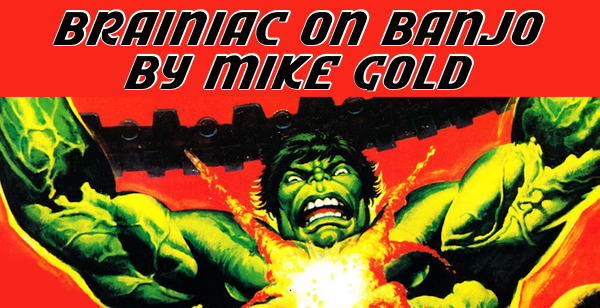
For example, the phrase “Hulking out” is known to and used by people who have never experienced the literary character upon which that phrase was based. These days “Hulking out” is used to refer to a person losing control or unnecessarily going over the top. Why, it’s even been used as a reference to our president du jour.

Making contributions to our language is nothing new to the comics art field. Certainly, those phrases made popular in media adaptations of comics still rattle though our conversations, such as “look up in the sky” and “holy ANYTHING.” Come to think of it, the phrase that predicates “Hulking out” is “You’re not going to like me when I’m angry.”

Of course, there’s that other Marvel phrase that started its invasion of our consciousness about, oh, 63 years ago that, after about a half-dozen Spider-Man movies, became a genuinely standard cliché: with great power, obviously, comes great opportunity.

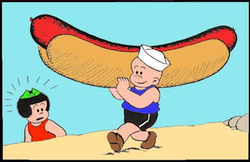
One of the best — and oldest — of such references may be apocryphal. I sure hope not, but, then again, I long have been in the business of printing the legend. So go know. I’m here to rat out the hot dog. Continue reading “Brainiac On Banjo: Hulking Out” →

Brainiac On Banjo: Fanfare? Tahh-Daaah!!!

Brainiac On Banjo: Fanfare? Tahh-Daaah!!!

“Resonating fanfare throughout the world. Replay it lightly towards the stage that you’ve been aspiring to. If your dreams aren’t able to come to an end yet, don’t give up.” — From Fanfare, written by Louise Frick Sveen, Atsushi Shimada, Kenichi Sakamuro, and Chiemi Ishiyama


I envy the hell out of Al Milgrom. He landed the best editorial gig in Marvel history, and then he proceeded to put himself right in the middle of it.

Al edited Marvel Fanfare, the linear anthology title that featured the work of a plethora of amazing writers and artists, all working on Marvel characters out-of-continuity. This is a “What If” scenario twisted so that the stories are not “What if,” but the talent is. So Al looked around, glanced at his magic Rolodex (google it), and turned out a ton of great stuff.

Contributors include Frank Miller, Barry Windsor-Smith, Chris Claremont, Dave Cockrum, Michael Golden, Mike Mignola, Charles Vess, Bill Sienkiewicz, Roger Stern, Marv Wolfman, Gil Kane, George Pérez, Bill Mantlo, Trevor Von Eeden, Paul Smith, Craig Russell, Kerry Gammil, Steve Grant, Jo Duffy, Mike Barr, Rick Leonardi, George Freeman, Terry Austin, Joe Rubinstein, and a whole lot of other people of exactly the same caliber.

My favorite of all these remarkably gifted folk was the one consistent presence in Marvel Fanfare: Al Milgrom himself. He’s even better than his Rolodex, and his “Editori-Al” one-pagers were clever, funny, self-effacing, and brilliant. Continue reading “Brainiac On Banjo: Fanfare? Tahh-Daaah!!!” →

Brainiac On Banjo: In Loving Memory

Brainiac On Banjo: In Loving Memory

“They hurt you at home and they hit you at school. They hate you if you’re clever and they despise a fool, ’til you’re so fucking crazy you can’t follow their rules.” From Working Class Hero, written by John Lennon.

President Rapist and his incel storm troopers have been spending the weekend reinforcing the belief that with great bigotry comes great cowardice.

On his Day One, our Commander-in-Treason ordered the termination of all discriminatory programs, including illegal DEI and “diversity, equity, inclusion, and accessibility” mandates, policies, programs, preferences, and activities in the Federal Government, including but not limited to Martin Luther King Jr. Day, Women’s History Month, Black History Month, Juneteenth, LGBTQ Pride Month, and Holocaust Remembrance Day. DEI has replaced “woke” as a plague upon those who decided to abandon their morals.

But you already knew that. If you didn’t, you would have quit reading about two dozen words back. Anyway, it is incumbent upon us to pick up the slack.

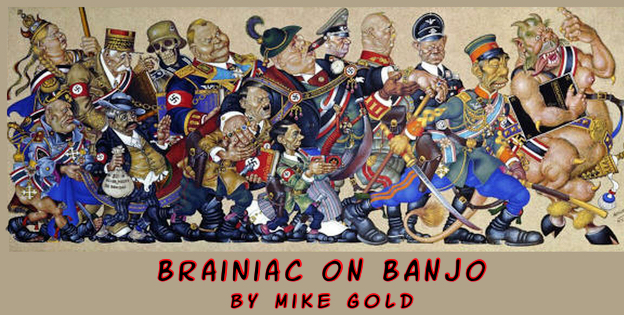
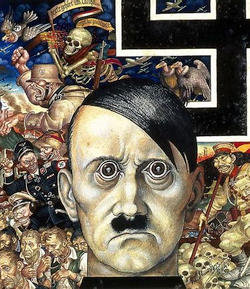
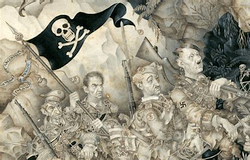
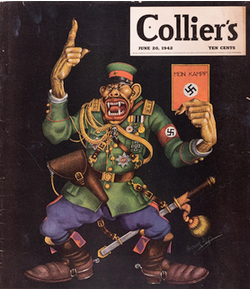
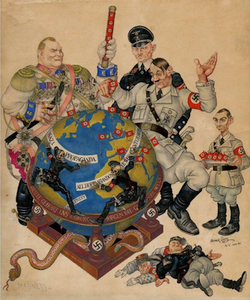
This week I’m going to start with an amazing cartoonist named Arthur Szyk (1894-1951), a.k.a. “Roosevelt’s soldier with a pen.” It was World War II, and that was a great time for editorial cartoonists, a job that now is quickly coughing up blood but had been exceptionally fruitful in its communication abilities.

The Jewish Press notes Szyk was raised in Soviet-occupied Poland to a cultural Jewish family (as opposed to religious Jewish; quite like myself, including the Russian/Polish heritage part). He was in London when Hitler invaded Poland and availed himself of the freedom his location to pick up his pen and “comment” on Hitler and the Nazis with a clarity that would be unimaginable had he still been in Poland. And, history informs us, he would have found his work to be terminal.

In New York City back in late 1942, Szyk joined Oscar-winning Hollywood screenwriter Ben Hecht, Broadway director Moss Hart, producer Billy Rose, composer Kurt Weill (“Three Penny Opera”) and others to create a dramatic pageant in the form of a production at Madison Square Garden about the plight of European Jews called We Will Never Die. It debuted the following March to a sold-out crowd before the show toured the nation. Szyk was the artist for the entire operation: posters, sets, promotional material, and such.

Szyk’s work speaks for itself. I wish I was fast enough to do this before Holocaust Memorial Day last week; as President Rapist announced, this holocaust thing is no longer a matter of concern for his United States government and the MAGA rodents for which it stands. His main TechBro Elon Musk then told people, particularly Germans, to get over it.

As for the rapidly disappearing art of editorial cartoons, the pestilence in the White House, with the uncanny help of Junior TechBro Bezos the Clown, have pretty much put the final nail in that coffin.

Sigh. MAGAts and Great American Assholes would do well to understand this. We have all this stuff in books, in other forms of print, on microfilm, in libraries public and private, not to mention in colleges as well, and, of course, on all sorts of computer servers and unlinked storage devices all over the world. The truth will not be ignored and you will spend the rest of your days looking over your shoulder pissing down your pants legs. In my book, that is a small price to pay for treason.

And, by the way, Black Lives still Matter.