


“Saw a big Brangus Steer standing right over there so I rustled up a fire, cooked him medium rare. Bar-B-Q’ed his brisket, a roasted his rump, fed my dog that ol’ Brangus Steer’s hump.” From Eat Steak, written by Jim Heath.
 Some find the term “comic book” to be annoying. By and large these pamphlets, now in many different forms and media, hardly are “comic” in the traditional sense of the word. Most contemporary stories are more or less along the lines of “let’s stop the world from ending,” although there are quite a number of tales about “what should we do now that the world has ended?”
We have another term that is of similar usage, although it’s a much more acceptable term. That word is “hamburger.” There’s no “ham” in hamburger. The United States Food and Drug Administration — assuming it’s still in business by the time you read this — has strict rules on how hamburger meat can be made, prepared and sold, and quite frankly these rules sound pretty useful. Well, unless you’re a vegan; I do realize several vegans actually read comic books, before they eat them.
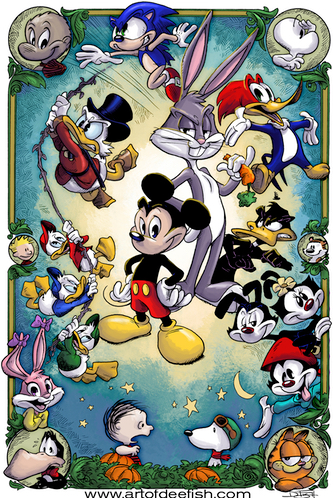 So you can’t find a hamburger made out of ham… and it’s damn hard to find a comic book that is comic.
Sure, there’s Mad, the wonder of my childhood and the entity that made me what I am today — well, that and the original Mars Attacks! cards. I discovered Mad when I was eight, having swiped a copy from my sister’s comics stash. I immediately conned my parents into subscribing. Back in those days we had “funny animal comics” and that category included Harvey’s ghosts, devils and ghouls as well as Dell’s Disney and Looney Tunes titles. But while these stories often were funny, they weren’t really “comic” in the LOL sense of the word. Please note, I greatly enjoy the works of Warren Kremer and Carl Barks; both then and now.
But when it comes to sheer off-the-wall humor, the stuff enjoyed by readers who preceded me became relatively extinct. Humor need not be linear, and it really shouldn’t be so constrained. I had to wait until the underground comix movement of the late 1960s for that sort of stuff, which I truly loved. This stuff changed the way I viewed American comics. I became friends with the likes of Jay Lynch, Skip Williamson, and Denis Kitchen, three brilliant cartoonists, who had they been born two generations later, might be in El Salvador today. Continue reading “Brainiac On Banjo: Hamburger In Four-Colors”
